
News
July 14, 2026
None of these people knew each other a year ago. Now they are part of the same story: 81 teams who have made it through the Online Bootcamp and Online Pitch Day of EIT Jumpstarter 2026, and have been selected to advance into Startup Builder Training, the programme’s hands-on middle stage.
Open the list of these 81 teams, now heading into Startup Builder Training, and you find something closer to a map of Europe’s anxieties and ambitions than a typical startup roster. Teams from 23 countries, from Türkiye and Malta to Moldova and Cyprus, are working on problems that rarely make headlines until they become emergencies: ageing electricity grids, fragile supply chains, burnout among knowledge workers, the slow leak of nitrates into European soil.
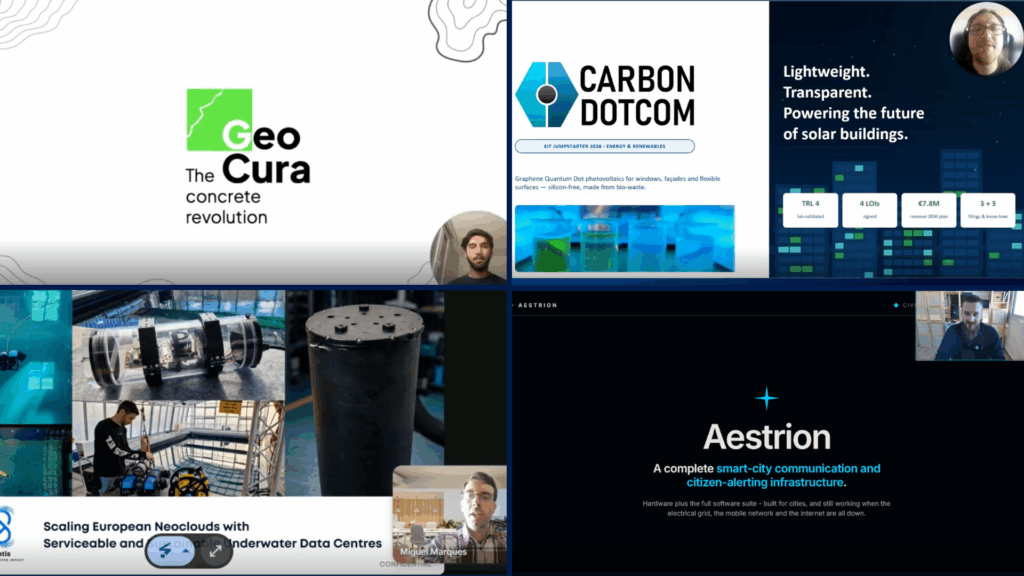
Take Aestrion, founded by Peter Borzak in Cyprus. His pitch does not start with a product feature. It starts with a gap: when the power or the internet goes down in a European city, there is currently nothing keeping ordinary people connected to emergency services. Aestrion is building the mesh network that fills that gap, doubling as everyday smart-city infrastructure and, when disaster strikes, a civilian lifeline.
Or consider GeoCura, a team spanning Portugal’s academic corridors, working to turn one of the world’s most hazardous industrial waste streams, mine tailings, into a self-healing construction material. They have already tested it in the civil engineering labs of Universidade Nova de Lisboa. Now they need what EIT Jumpstarter offers: the discipline of a real business model to match the science.
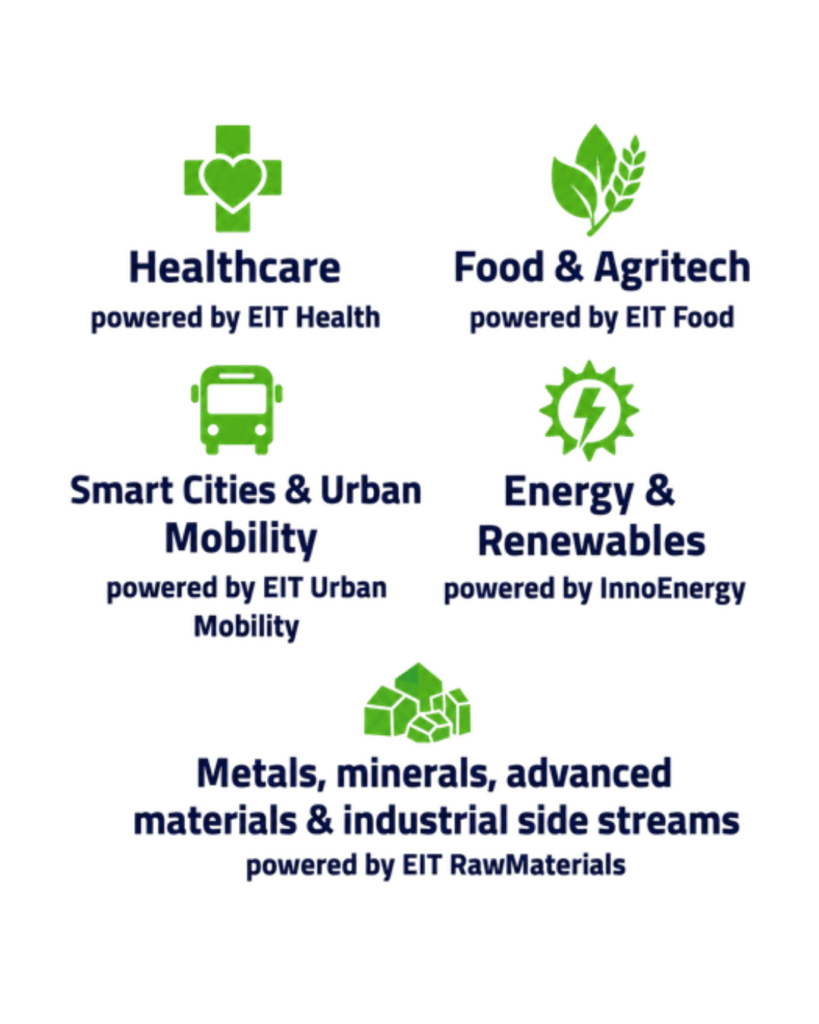
These 81 teams are spread across six thematic tracks: Healthcare, Energy and Renewables, Smart Cities and Mobility, Food & Agritech, Raw Materials: metals, minerals and industrial side streams and additional thematic agnostic Malta’s dedicated national track. Each of them powered by a different EIT Knowledge and Innovation Community or their partner in this year edition Xjenza Malta.
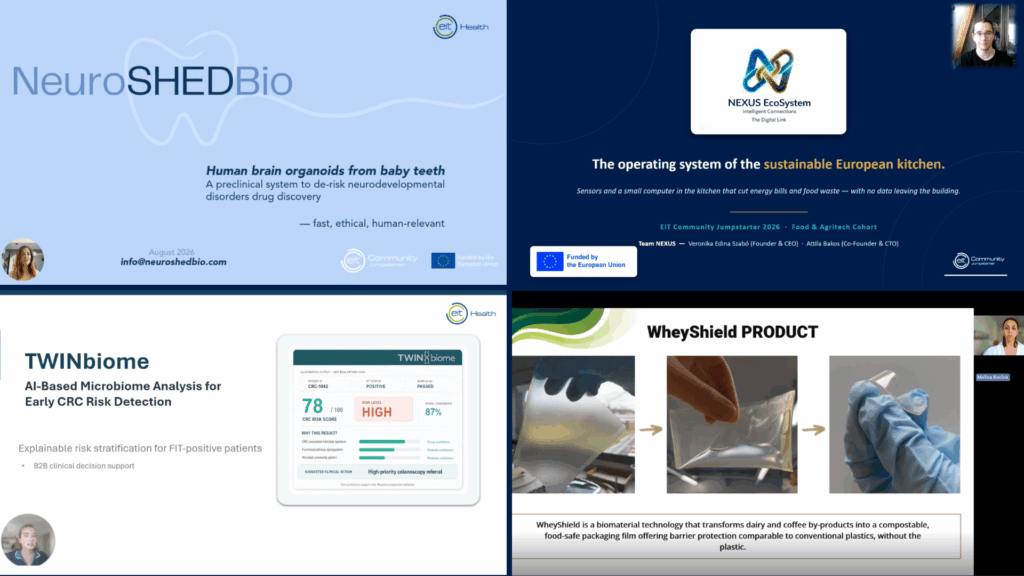
Inside Healthcare, the range is striking. TWINbiome, founded by two microbiome researchers who have already sold nearly a million lira of testing services through a previous venture, wants to turn a stool sample into a colorectal cancer risk score. A few teams along, MTB-cBioPortal is trying to give Molecular Tumour Boards, the teams of specialists who decide how to treat the hardest cancer cases, a shared digital workspace built on an open-source platform already used by clinicians worldwide.
In Energy and Renewables, Datlantis is proposing something that sounds almost like science fiction until you check the physics: underwater data centres, co-located with offshore energy farms, offering three times the compute density at a third of the cost of traditional facilities. Meanwhile in Poland, FlexQuantumPV is working on flexible, silicon-free solar cells made from graphene quantum dots derived from bio-waste, aimed at turning ordinary windows and facades into power generators.
Food & Agritech tells its own quiet story of circularity. WheyShield, a Slovak team, is turning whey protein and spent coffee grounds into biodegradable food packaging. Terra Mysia, led by a solo founder and PhD candidate in Türkiye, is building a zero-waste olive biorefinery that transforms leaves and pomace, usually discarded by the ton, into high-value functional oils.
Read together, the numbers tell the same story as the pitches themselves: a cohort that is genuinely mixed, in geography, in team size, in experience, and in how far each idea has already travelled before reaching EIT Jumpstarter.
Some of these founders are stepping onto an accelerator stage for the first time. Others bring hard-won experience from elsewhere in the EIT network, even if EIT Jumpstarter itself is new to them, since former Jumpstarter participants are not eligible to re-apply. Some founders were encouraged to apply by EIT Community Officers who actively support local startup ecosystems in EIT RIS-eligible countries. Many founders heard about EIT Jumpstarter through the programme’s alumni network, a small sign of how tightly the wider EIT community is connected.
That mix, first-timers standing shoulder to shoulder with founders who already know their way around local or regional ecosystem, is part of what gives this cohort its texture. Nobody arrived at the Online Bootcamp as a finished product. Everybody arrived with something worth testing at the European level, and worth building on now, in EIT Jumpstarter Startup Builder Training.
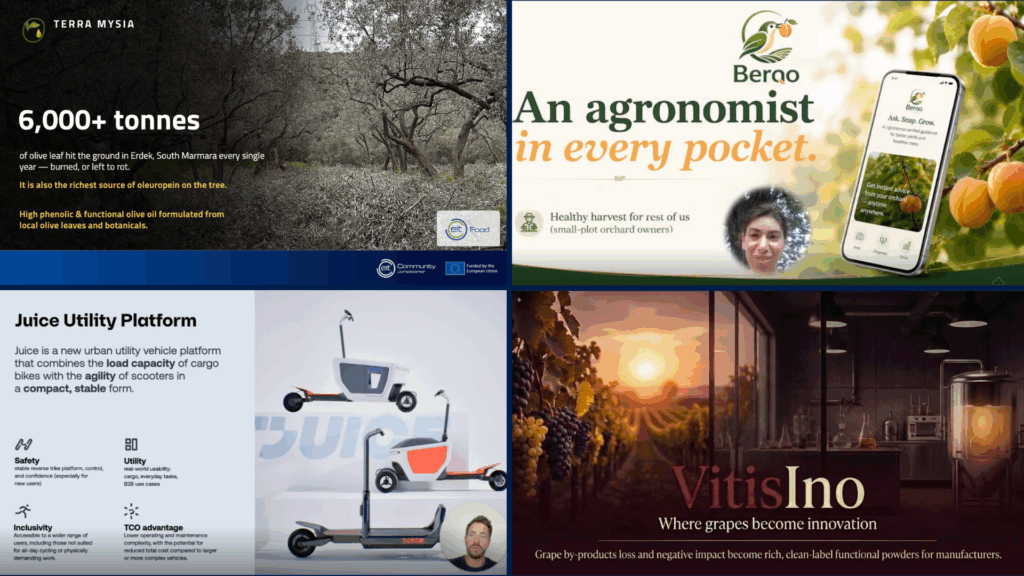
These 81 teams have already done the qualifying rounds: the Online Bootcamp, roughly 15 hours of self-paced modules and live webinars, and the Online Pitch Day, where they recorded and defended a pitch video in front of a jury. Now, through the summer, they are in Startup Builder Training, a mix of in-person workshops and online sessions designed to stress-test their assumptions, sharpen their pitch, and produce a concise Business Plan.
From here, the path narrows. By the end of September, each team must submit that Business Plan along with proof that they are ready to incorporate a company, or already have. Only the strongest, up to six per thematic track, will be invited to pitch live at the Grand Demo Day in October. There, a jury will select the top three teams in each track for prizes of up to EUR 10,000, alongside special prizes for solutions aligned with the New European Bauhaus, Rebuild Ukraine, the Western Balkans, and the EU Outermost Regions.
Reaching Startup Builder Training is a real milestone, not a finish line. What comes next, for each of these 81 teams, is the part of EIT Jumpstarter that matters most: turning a promising idea, tested and refined over the summer, into a business model that can carry it into the autumn and beyond.
Subscribe to Our Newsletter
Copyright EIT Jumpstarter © 2025 All Rights Reserved
| Cookie | Duration | Description |
|---|---|---|
| cookielawinfo-checbox-analytics | 11 months | This cookie is set by GDPR Cookie Consent plugin. The cookie is used to store the user consent for the cookies in the category "Analytics". |
| cookielawinfo-checbox-functional | 11 months | The cookie is set by GDPR cookie consent to record the user consent for the cookies in the category "Functional". |
| cookielawinfo-checbox-others | 11 months | This cookie is set by GDPR Cookie Consent plugin. The cookie is used to store the user consent for the cookies in the category "Other. |
| cookielawinfo-checkbox-necessary | 11 months | This cookie is set by GDPR Cookie Consent plugin. The cookies is used to store the user consent for the cookies in the category "Necessary". |
| cookielawinfo-checkbox-performance | 11 months | This cookie is set by GDPR Cookie Consent plugin. The cookie is used to store the user consent for the cookies in the category "Performance". |
| viewed_cookie_policy | 11 months | The cookie is set by the GDPR Cookie Consent plugin and is used to store whether or not user has consented to the use of cookies. It does not store any personal data. |